


The Invisible War: Understanding Depression, Anxiety, and the Truth About Mental Health
- Constantinos Theodorou (Tino)

- Nov 11, 2025
- 5 min read
Updated: Nov 21, 2025

There’s a silent epidemic most people still misunderstand.
It doesn’t show on X-rays, can’t be stitched up, and doesn’t always come with tears. Yet it breaks millions from the inside out. We call it depression, anxiety, mental illness — but for many, these words are still just “moods,” “weakness,” or “excuses.”
Too often, those who haven’t experienced it say things like:
“Just go out.” “Do something fun.” “Get over it.”
But here’s the truth: there’s a vast difference between feeling down because of a bad day and feeling empty, hopeless, or anxious because your internal system is misfiring.
Mental illness isn’t just in your head — it’s in your biology, your chemistry, your entire nervous system.
When the Mind Itself Short-Circuits
For years, I was one of those people who thought depression was a matter of attitude. I used to say, “Come on, it’s just in your mind — snap out of it.” Until the day my own mind stopped obeying me.
During one of the hardest periods of my life, the pressure, stress, and emotional exhaustion built up until something inside me broke. My body and mind crashed. I was diagnosed with fibromyalgia, but the physical pain was only part of it.
What came next was a storm I couldn’t think, talk, or “positively affirm” my way out of.
Days and months went by where I could barely get out of the house. I felt detached from reality, lost in a dark place. My mind was foggy, my heart was racing, my body ached in ways words can’t describe. Panic attacks came in waves, anxiety crept into every corner of my being, and the simplest things felt impossible.

I tried everything I knew — positive thinking, affirmations, meditation, natural remedies — but nothing worked. Because the issue wasn’t “in my mind.”
It was in my brain.
My entire internal system had crashed. And no amount of willpower could override broken biochemistry.
That was the day I understood what so many others live with every single day. It hit me: this is what depression feels like.
Not sadness — but emptiness.
Not weakness — but malfunction.
Depression Is Not Weakness — It’s a Biological Crisis
Science is clear: depression, anxiety, panic disorder, and many other mental health issues stem from real physical imbalances — changes in neurotransmitters like serotonin, dopamine, and norepinephrine; hormonal dysregulation; inflammation in the body and brain; chronic stress overload; even nutritional and sleep deficiencies.
When your neurochemistry is off, your perception, energy, and emotions spiral. You don’t just “feel bad.” Your body literally loses its ability to regulate mood, motivation, and calmness.
You can’t “walk it off.” You can’t “cheer up.” Because it’s not a matter of will — it’s a matter of biology.
The Irony of the Self-Help Industry
Ironically, I was deep in the personal development world when it all happened — running mentorship programs, attending seminars, and working with life coaches and motivational speakers.
That experience opened my eyes to a dark truth: many in the self-help industry, though well-meaning, don’t understand mental health at all. They preach motivation to people whose nervous systems are in survival mode. They tell the deeply depressed to “raise their vibration,” “just take action,” or “focus on gratitude.”
But when your biochemistry collapses, motivation slogans don’t fix it — they can make it worse.

Behind closed doors, I saw some of those same “gurus” ridiculing people struggling with mental illness — calling them lazy, crazy, weak, “energy drainers.” That was the day I walked away from that world.
Because helping people means understanding people, not feeding your ego through their pain. You can’t coach someone out of depression if you don’t even understand what’s happening inside their body.
True guidance requires studying psychology, biology, nutrition, trauma, and environment — not just reading a Tony Robbins book and calling yourself a life coach.
Healing Requires Both Compassion and Science
I was against medical treatment for a long time. I believed in natural healing, in mindset, in self-control. But after months of relentless suffering, I realized that sometimes the body needs assistance — just like when you take painkillers for a headache.
Medication, when used wisely, isn’t weakness — it’s stabilization. It doesn’t cure the cause, but it gives you enough strength to work on it.
Because you can’t heal your mind when it’s drowning. Sometimes you need to quiet the storm before you can rebuild the ship.
Healing mental illness requires a holistic approach — addressing the mind, body, spirit and environment.
Yes, mindset and environment matter deeply. Stress, isolation, trauma, toxic people — all of these can trigger or worsen mental illness. But we must also treat the biological side, restore balance, support the body, and create safe environments where people aren’t shamed for needing help.
Even Those Who “Have It All” Can Fall Apart
If depression was simply about circumstances, the rich and famous would be immune. Yet, we’ve lost incredible souls — Robin Williams, Chester Bennington, Anthony Bourdain — people who had everything society defines as “success.”
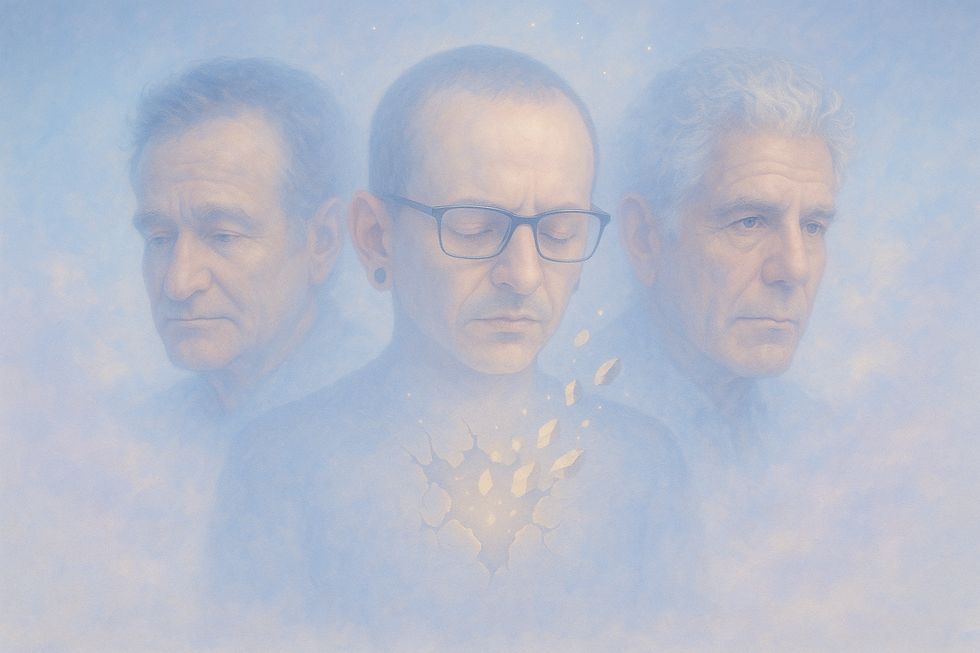
Their tragedies prove something vital: mental illness doesn’t discriminate. It doesn’t care how much money you have, how many followers you’ve got, or how many people love you. Because it’s not about the outside world — it’s about what’s happening inside your brain.
The Stigma Must End
We still live in a world where seeking therapy or taking antidepressants is whispered about, while physical illness gets sympathy and support.
If you break your leg, no one tells you to “just think positive.” But if your mind breaks, suddenly you’re told to “snap out of it.”
This stigma isolates millions of people who are already in pain. It makes them hide their suffering, delay seeking help, and spiral deeper into despair.
Judgment always stems from ignorance. Education is the cure. The more we understand that depression is a medical condition, not a personal flaw, the more compassion we’ll show — and the more lives we’ll save.
Seeking Help Is Strength, Not Weakness
Asking for help doesn’t make you fragile — it means you’re fighting back. Whether it’s therapy, medication, lifestyle change, or simply admitting you’re not okay — that’s not giving up. That’s taking your first step toward recovery.
Mental illness is not a choice. But healing is. And it begins with honesty — with saying, “I need help.”

The Final Truth
Depression, anxiety, and other mental health disorders are not character flaws. They are biological, psychological, and emotional storms that deserve care — not criticism.
We all need to learn to be gentler — with ourselves and with others. We never truly know the battles someone is fighting beneath their smile, or the weight they carry in silence.
Sometimes, the strongest people are the ones holding everything together while no one notices they’re falling apart.
A kind word, a patient ear, or simply being present can make an enormous difference to someone who feels invisible.
So be compassionate. Be patient. Be understanding. Don’t rush people’s healing, and don’t judge what you cannot see.
Sometimes, the smallest act of kindness can reach where medicine can’t.
Because in a world that can feel so cold, empathy is medicine. And every soul you treat with compassion — including your own — brings us one step closer to healing this invisible war together.

When we finally start treating mental health as we would any other illness — with compassion, science, and understanding — the stigma will fade, and healing will become possible for all.
Until then, remember this:
You are not broken.
You are not weak.
You are human — made of both mind and chemistry, light and shadow.
And you deserve to heal.
If you enjoyed this reflection, you may also like my book Awaken Within: The Book of Knowledge — https://www.amazon.com/-/en/dp/B0FVFSKVWV


Comments