


Beyond the Interface: Why Reality Is Not What We Think It Is
- Constantinos Theodorou (Tino)

- Nov 20, 2025
- 7 min read
Updated: Nov 21, 2025
Consciousness, Code, Hidden Rules, and the Illusion of the Physical World
(Inspired by Donald Hoffman and the deeper truth behind quantum physics)

For centuries we’ve believed that our senses give us a direct window into reality — that the world “out there” is exactly as we perceive it.Solid objects, stable laws, definite positions, linear time.
But the deeper we look — through quantum experiments, through cognitive science, through philosophy — the more everything points to one unsettling conclusion:
We are not seeing reality. We are seeing an interface.
And if that’s true, then everything we assume about what’s possible — our limits, our abilities, our physical constraints — is built on the shallow surface of a far deeper structure.
This is exactly the idea American cognitive scientist Donald Hoffman has been pushing for years:
Consciousness is fundamental. Space, time, and physical objects are icons.
But what does that actually mean?
And how does this connect to physics, to “breaking the rules,” to the possibility of hidden powers, and to the idea that we’re avatars inside a cosmic game whose real engine lies beyond our perception?
Let’s unpack it — from the ground up.
Who is Donald Hoffman, and why should we take him seriously?
Before diving deeper, it’s important to understand who Hoffman actually is.
Donald D. Hoffman is an American cognitive psychologist and a professor emeritus at the University of California, Irvine. He holds a PhD from MIT and has spent more than four decades studying perception, consciousness, mathematical models of the mind, and evolutionary game theory. He has published in top scientific journals, received awards from the American Psychological Association, and co-authored mathematical papers showing—rigorously—that evolution favors organisms that perceive useful illusions over those that perceive the truth.

Hoffman is not a fringe thinker.He is a respected academic presenting a mathematically grounded, scientifically argued, and deeply challenging theory:
Reality is nothing like the world we perceive.
This context matters, because it means the ideas you’re reading are intellectually serious, academically rooted, and philosophically profound—not new-age speculation.
1. The Double-Slit Experiment: The First Crack in the Illusion
The iconic double-slit experiment is often misunderstood as “consciousness collapses the wavefunction.”

It doesn’t. No human mind, no expectation, and no intention has any effect on the outcome.
What collapses the wavefunction is something much simpler:
Physical interaction. Information entering the environment.
A detector, a photon, a molecule — anything that records which path the particle took.
The surprising part is that this collapse happens even if no human ever sees the data. It happens automatically — as if the universe itself runs a background process that “renders” one outcome from many possibilities.
This forced physicists to confront something uncomfortable:
The world does not exist in definite form until the code renders it.
Not because of observation —but because of interaction, just like a video game engine renders a scene only when the player enters it.
The particle doesn’t decide. The human doesn’t decide. The detector doesn’t decide.
The underlying engine decides.
Which raises a deeper question:
What exactly is this engine?
And why do we only experience the rendered frame, never the rendering itself?
2. The VR Analogy: Consciousness as the Player Outside the Game
Imagine putting on a VR headset.

Inside the game you see:
objects
walls
landscapes
physics
avatars
enemies
missions
But none of that is literally there. It’s a representation generated for your benefit.
Your eyes, in the VR world, are not real. Your “body” in the VR world is not real. Gravity inside the VR world is not real.
What is real?
The player, the conscious experiencer, outside the simulation.
This is exactly Hoffman’s argument:
“Space, time, and physical objects are the VR desktop, not the actual hardware of reality.”
Your brain is the headset. Your body is the avatar. Your senses are the interface elements. The world you perceive is the rendered environment. The true “you” is not inside the simulation at all.
3. Why Evolution Did NOT Give Us the Truth
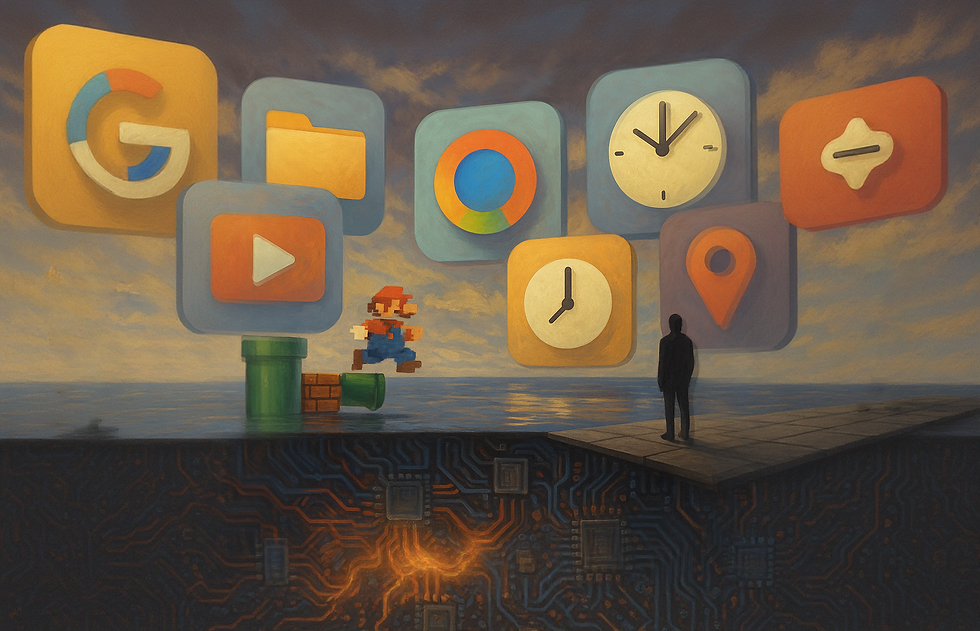
Hoffman’s mathematical models show something radical:
**Organisms that see the truth lose.
Organisms that see only what’s useful win.**
Just like your computer desktop hides electrons, transistors, and voltage patterns behind friendly icons…
…your visual, auditory, and tactile experiences hide the deeper reality behind a set of simplified icons:
objects
colors
distances
space
time
These aren’t the real “things.”They’re the user-friendly symbols evolution installed to keep us alive.
The truth would be too complex, too costly, too slow.
So we see the illusion, not the engine.
Just like Mario sees platforms, pipes, and Goombas —not the C++ code underneath.
4. Physics Confirms It: Space-Time Is Not Fundamental

Modern physics has quietly started saying something shocking:
Space-time is doomed.
It’s not fundamental. It breaks down at quantum scales. It fails inside black holes. It cannot unify with quantum mechanics.
This means:
Space and time — the most basic “laws of reality” — are surface-level projections.
They are not the code. They are part of the interface.
Quantum entanglement, nonlocality, tunneling — these are all hints that something deeper, stranger, and not bound by conventional laws is operating beneath the surface.
Just like hidden mechanics in a video game that no beginner player would ever imagine existed.
Here, Hoffman adds a profound insight:
If space-time is not fundamental, then neither are particles, fields, or brains. If our brains are icons on an interface, then consciousness cannot depend on the brain — the brain depends on consciousness. This completely reverses the materialist worldview.
**5. Are There Hidden Rules in the Code?
Here’s where things get interesting.

If reality is an interface…If our senses only show a simplified model…If physics is incomplete and emergent…If consciousness is deeper than matter…
Then your question becomes valid:
Could the deeper code allow things that seem impossible inside the interface?
Not by breaking physics —but by accessing higher layers of the engine.
This is not far-fetched.
Quantum physics already allows:
teleportation (of information)
matter tunneling through barriers
nonlocal correlations
vacuum energy “from nothing”
particles in multiple places at once
time dilation
matter appearing from fluctuations
These effects don’t break the code. They are the deeper code.
We simply don’t have access to them at the macroscopic avatar level.
But evolution didn’t optimize us for truth —so who knows what deeper abilities remain hidden?
And Hoffman’s own research on “conscious agent networks” suggests the engine beneath space-time is far richer, more flexible, and more dynamic than anything allowed by standard physics. In principle, if consciousness is the fundament, then phenomena we consider extraordinary could simply be ordinary behaviors of the deeper substrate we haven't yet learned to access.
No scientist alive today can say with certainty:
what’s fundamentally impossible
or what humans might eventually access through technology, training, or altered states of consciousness.
We simply don’t know the engine well enough.
6. Hoffman vs. Simulation Theory: Similar Surface, Different Depth
People often confuse Hoffman with the simulation hypothesis (Elon Musk, Bostrom, etc.).But Hoffman’s view is far more radical.

Simulation Theory:
There’s a physical computer in some other universe running our simulation.
Hoffman’s Theory:
There is no physical world outside the interface. Reality is composed of interacting conscious agents, not matter. The “simulation” is not running on hardware —it is a dynamic web of conscious experiences.
In simulation theory, you are Mario. In Hoffman’s theory, you are the player, and Mario is only your avatar.
This distinction matters profoundly. Simulation theory keeps materialism alive; Hoffman ends it. Simulation theory says consciousness is generated by the simulation; Hoffman says consciousness generates the simulation.
7. The Avatar vs. the Player: The Limits and the Possibilities

Inside the game:
Mario can’t rewrite the engine.
Mario can’t walk through walls (unless there’s a hidden glitch).
Mario can’t fly (unless there’s a power-up).
Mario can’t exit the simulation.
But the player outside the game:
can install patches
can use cheats
can change settings
can mod the game
can delete it
can remake it
If consciousness is truly “outside” in Hoffman’s sense…
Then yes: some form of meta-level ability or access might exist.
But here’s the truth:
As long as we are logged into the avatar, we are bound by avatar-level rules.
We can only navigate the interface —not rewrite the engine.
At least not yet.
**8. The One Thing We Can Change: Our Path Through the Code.

Even if we can’t break the deep laws, we absolutely can change:
our perception
our decisions
our mindset
our emotions
our focus
our environment
our behaviors
These do not rewrite physics —but they drastically reshape our reality experience.
They are the true “cheats” evolution hid inside the interface.
Master perception → your world changes. Master focus → your opportunities multiply. Master emotional state → your timeline shifts. Master identity → your character evolves.
This is not magical thinking. This is how the avatar interacts with the interface to discover different regions of the code.
**9. The Final Insight:
Reality Is Far Bigger Than We Imagine.

After all the analogies, science, and philosophy, here’s the core truth:
We are consciousness operating inside an interface built for survival, not truth.
We confuse the icons for the underlying reality. We mistake the desktop for the computer. We mistake the avatar for the player. We mistake the laws of the interface for the laws of the engine.
But deep down we feel the truth:
There is more to reality than the senses show.
There are deeper rules we haven’t discovered.
There is a layer of existence outside space and time.
Consciousness is not inside the world —the world is inside consciousness.
Hoffman gives this intuition a scientific voice.
Quantum physics gives it mathematical glitches.
And philosophy gives it ancient echoes found in every tradition.
Maybe we can’t fly, teleport, or alter physics yet. Maybe the avatar is limited.
But the player is not. And the interface is only the beginning.
And the deepest truth of all:
The world we see is not the world that is.

It is merely the interface we evolved to navigate it.
Objects are icons. Space and time are icons. Your body is an icon. Even your perceived “self” is an icon.
The deeper reality — the engine — is a vast network of consciousness interacting with consciousness.
You are not trapped inside the simulation. You are only trapped inside the interface of your senses.
You are the player, not the avatar.
And the illusion dissolves the moment you realize this.
If you enjoyed this reflection, you may also like my book Awaken Within: The Book of Knowledge — https://www.amazon.com/-/en/dp/B0FVFSKVWV


Comments